The Art of Being in Flow

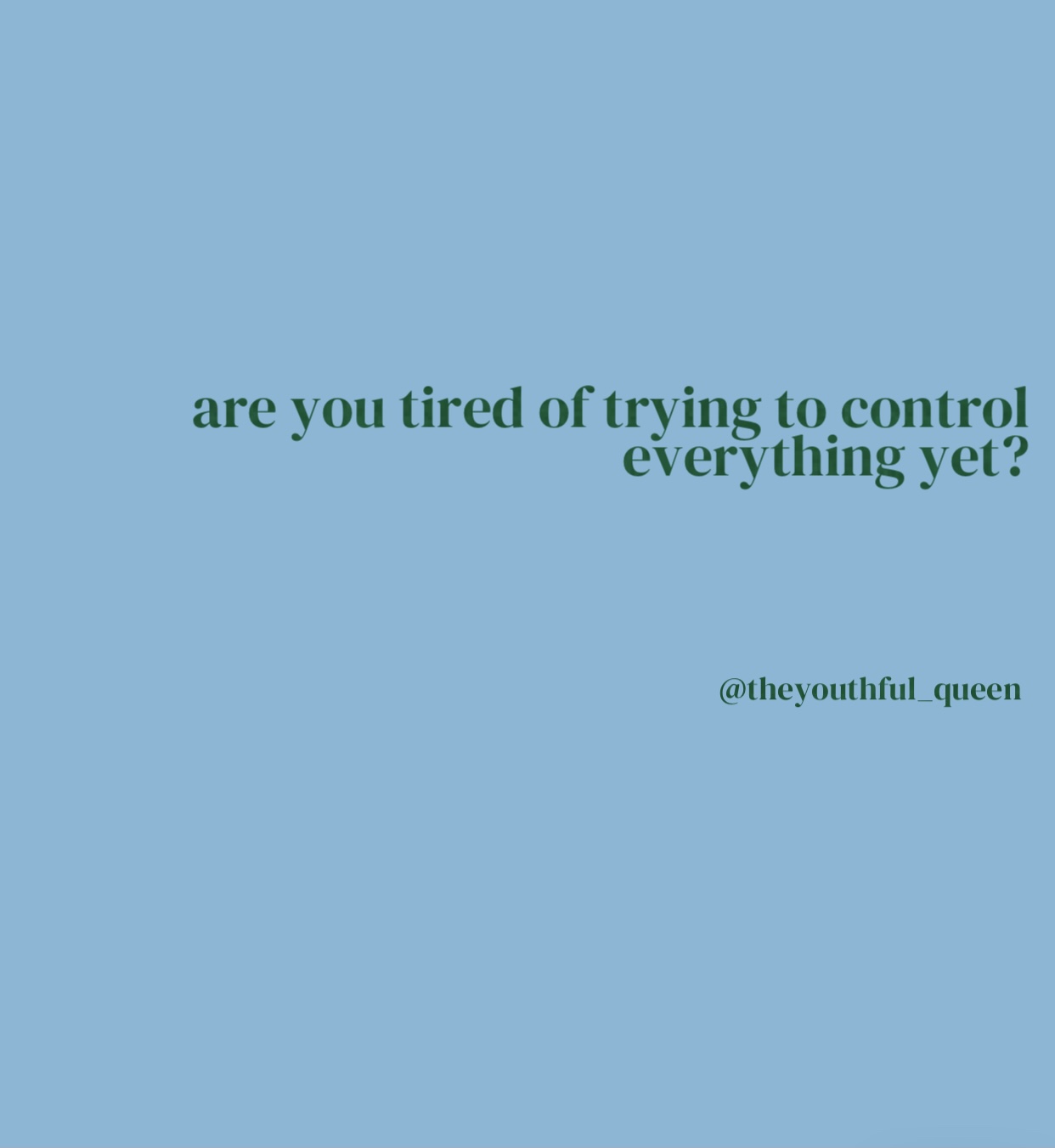
Do you really trust your Creator?

Do you even trust yourself?

From self-observation, one will find there are many ego games at play all in one instance. When we talk of surrender, we literally mean the ability to be able to completely relinquish control— or the illusion of such in which we place our faith in the hands of our Creator. Surrender requires trust: understanding that God’s plans are much more unbounded and perfect than our own. Some may say that they find surrender on the mat in the midst of yoga. When one contorts their body into pretzel-like poses or even a simple leaning forward onto stretched out legs, feeling muscles pulse in their struggle to release its hold, break, tear and form deeper into this shape.

Or perhaps surrender comes during that moment in meditation where words become sparse and one begins to hear sounds circling around them. Listening to cars whiz by; laughter from children across the street at a playground; birds in flight, the wind carrying melodious chirps or; a slight ringing sound of silence. In those moments where oneself begins to blend with the world around them, the realization that separation is the mass hallucinogenic illusion we’ve all implicitly agreed upon becomes ever so clear.

Maybe surrender arrives in the midst of prayer. When a chant and intention becomes vibration—pulsating across a thousand membranes and cells implanting itself through muscle memory. Our voices mirroring the very tremors that shaped the universe. With Gods name heavy on our tongue, hearts begin to tremble at the humble awareness of the familiar essence of its Creator. Reverence becoming our name, we bow our heads in humility understanding our own creation and God’s mercy in manifesting us.

In reality, many humans have issues with surrender in many aspects of daily living. Perhaps it’s a trouble to commit to a routine, to acknowledge our imperfection, a negligence to pull ourselves from self-importance, a lack of humility, difficulty with bowing our heads in prayer or even admitting that we do not have all of the answers.

The lesson of surrender arrives in many forms; in many that we have endured during this very year. As difficult as it may get, I am keen to remember that surrender often arrives in places where God seeks to be revered. In these spaces, we are asked to drop the force of “personal will” to allow something much bigger and wiser than ourselves to emerge. We are joined with the force of nature which knows no illusory separation and fully submits itself to the will of the Creator, following His commandments. And due to this submission, nature poses as eternally and infinitely beautiful—a reflection of God Himself which stands as a reminder to those whom seek wisdom. This wisdom allows for us to reclaim the seat of our being, causing the to submergence into submission and reemerge of our likeness of God, thus returning to our own timeless divine nature. In this we never fear the illusion of death as we return to infiniteness.

Thus our very breath turning into a return, reverence and prayer to The Most High.

The Psychology Behind Manifestation

red and white lighthouse on land
Photo by Tom Swinnen on Pexels.com

Its that time of year again. In between making plans for holiday events, running around searching for that perfect gift and figuring out what the hell your new year’s resolutions are this year- taking the time to sow seeds for the new year can seem damned-near impossible.

In lieu of this new age spirituality, talk of “manifesting your dreams into reality” has become extremely mainstream. The idea of manifestation and law of attraction is that by focusing on negative or positive thoughts the universe will bring corresponding negative or positive experiences into one’s existence.  While this idea seems harmless enough, many people have trouble believing in it because it has little to no scientific research to back it up. However, in purely psychological terms, it is not uncommon to believe that one’s perception creates their reality.

One interpretation of this personal perception is called a self-fulfilling prophecy. Self-fulfilling prophecy is when our beliefs and expectations influence our behavior at the subconscious level. When this happens, our subconscious actually enables us to act out our beliefs and therefore, bring them into existence.  In fact, in a study done by Pantich, D. & Jones, S.C (1971) they found that there is a tendency for individuals to act in a certain way to fulfill their prophecies or beliefs even when it comes to other people. In this particular study, in showing mutual attraction toward a stranger, person A would display positive actions according to their personal thoughts and beliefs that person B liked them. What did the results show? Well, results displayed that person B often would have more positive general feelings toward their partners! This resulted in both partners reporting that they had mutual increases in their personal evaluation of likeability in one another.

The key to understanding this phenomenon is that manifestation is a battle of both the mind and the action. It is imperative to have positive beliefs first because these beliefs affect your perception and then consequently, your actions. When your actions reinforce your beliefs these then turn into self-fulfilling prophecies or as we call it nowadays- manifestations.

So as mentioned in the beginning, it is the end of the year and the perfect time to sow the seeds for a positive, hopeful outlook on the new year. However, it’s not just enough to set goals and hope for the best. In order for your dreams to turn into reality, it helps for you to alter your belief system and perceptions around attaining them. As time has proven over and over again, change is an inside job first and then transmutes outward last.

Here are some tips on manifesting your best year yet:

  1. Ask yourself: “what disabling beliefs am I holding about attaining my goals and dreams?”

You cannot manifest anything if you hold beliefs that are inevitably self-sabotaging your dreams. You need to assess if you are holding any disabling or negative beliefs about what you want to accomplish before you attempt to make your dreams into reality. Clear out your blocks first, then space will open up for newness to blossom next.

  1. What enabling beliefs do I wish to replace the disabling ones with?

After going in and plucking all of those negative beliefs and ideas from its roots, take the time to replace them with new ones that will enable you to manifest the life that you desire.

  1. How do I want my next year to feel?

It’s helpful to provide imagery of your perfect life, however, lasting results comes from being able to feel in your body what you want your experience to be. How do you feel when you are at your best – when you drop all identities and you are at your rawest, unfiltered, divine self? Maryam Hasnaa calls this feeling your home frequency. When you master naming this feeling, you are able to create situations you know is in alignment with YOUR truth.

For this, it helps to sit in meditation and envision imagery of your ideal self and life. Take notice of how your body feels. Does this imagery make you feel good? Do you feel happy? Is your heart pleased with this? Does it feel in alignment with your best-self, your truth? This is step is key for future reference because if the feeling in your body is in alignment or contradictory to the feeling you want to create, you will know because you’ve already studied what your home frequency is.

  1. What steps will I take to make this next year feel like this?

After you study and master what your home frequency is, begin to create experiences that allow for you to embody that frequency. This is where you lay out the personal steps you will take in order to honor your truest self, purpose and divine nature.

As many psychologists and scientists have proven, reality is a construct that is filtered through one’s personal perception. So remember: mastering your reality will always begin with mastering yourself.

References: Panitch, D. Jones, S.C. The self-fulfilling prophecy and interpersonal attraction. Journal of Experimental Social Psychology. Volume 7, Issue 3. 1971.Pages 356-366. ISSN 0022-1031. https://doi.org/10.1016/0022-1031(71)90034-5.